LegalGPS helps entrepreneurs and small businesses navigate legal complexity through educational content and contract templates. The site is run by Chris Daming, a founder who learned SEO the same way many product builders do by necessity, experimentation, and gradual iteration.
This success story shows how LegalGPS used LinkStorm as a set and forget internal linking layer to scale content and significantly grow organic traffic without ongoing manual SEO work.
The challenge: scaling content without scaling SEO effort
Like many content driven businesses, LegalGPS started publishing articles to raise awareness and support product pages. Over time, some blog posts that were two or three years old began attracting meaningful traffic.
That raised a new question. How do you reinforce the most important pages across a growing content library without spending hours manually inserting links.
Chris had already adopted a classic pillar page approach. Core pages existed. Supporting content existed. The missing piece was consistent internal reinforcement at scale.
Manually identifying which pages should link to which targets quickly became a bottleneck. As content velocity increased, internal linking became slower than writing the content itself.
Trying existing tools and hitting quality limits
To solve this, Chris tested several automated internal linking tools. Many were tightly coupled to WordPress or HubSpot and were not a fit for his setup. Others initially looked promising but introduced a different problem.
As more links were added, link quality degraded.
Anchors felt generic. Targets felt arbitrary. The system required frequent supervision to avoid low value or confusing links.
One of those tools was Linkbot, which Chris used for several months before deciding it was not sustainable long term.
Switching to relevance first internal linking
When Chris returned to LinkStorm, the difference was immediately noticeable.
It was the smartest internal linking tool I tried. The links it suggested were the closest to what I would have done myself.
‒ Chris Daming, CEO & Founder Legal GPS
Rather than aggressively inserting links, the platform prioritized semantic relevance between source content and target pages. Suggested anchors closely matched what a human would naturally choose. Low relevance links were filtered out automatically.
This aligned well with Chris’s goal. He did not want to micromanage internal links. He wanted the system to behave the way he would, without needing to be involved.
How LinkStorm was used at LegalGPS
The setup was intentionally simple.
• The snippet was installed
• Auto accept was enabled
• No manual review process was added
• No special rules or silos were configured
LinkStorm was allowed to run continuously in the background, discovering opportunities and reinforcing important pages as new content was published.
This matched Chris’s operating style as a founder. Minimal tooling overhead. Maximum leverage.
The result: sustained organic traffic growth
Over the following months, organic sessions increased steadily.
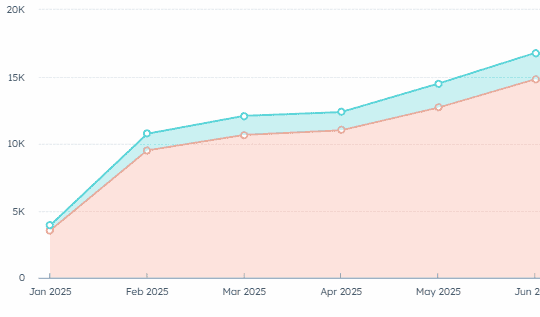
From January 2025 to July 2025, LegalGPS went from fewer than 5,000 sessions per month to more than 15,000 sessions per month. Traffic growth followed a smooth upward curve rather than a short lived spike.
While internal linking was not the only factor, it played a key role in helping search engines better understand page importance, relationships between topics, and which pages deserved prominence.
Why this matters for founders and small teams
This story is not about complex SEO workflows or constant optimization.
It shows what happens when internal linking is treated as infrastructure rather than a task.
For solo founders and small teams, LinkStorm removes a class of SEO work that normally requires ongoing attention. Once installed, it continues to support content growth without additional effort.
For LegalGPS, that meant staying focused on building content and products while internal links quietly did their job in the background.
That is exactly how Chris wanted it to work.
Leave a Reply